
How Deep Can a Diamond Core Drilling Rig Drill? A Complete Guide to Core Drilling Depth Capability
Drilling depth is the core benchmark that determines the success and accuracy of mineral exploration, geological survey, and resource assessment projects. For project contractors and mining investors, the most frequently asked question is how deep can a diamond core drilling rig drill.
Many users mistakenly believe the maximum drilling depth depends solely on the rig’s nominal parameters. In fact, the actual drilling depth is affected by multiple key variables including rock formation conditions, drilling methods, core barrel size, drill rod strength, machine power, and operator experience. In general, a high-quality diamond core drilling rig can achieve drilling depths ranging from several hundred meters to over 1500 meters, based on equipment configuration and on-site geological conditions.
Typical Drilling Depth Range of Diamond Core Drilling Rigs
Diamond core drilling rigs are classified into three mainstream types according to depth capacity and functional positioning, each matching specific project scenarios and geological exploration needs. The following table details the standard depth range and core application scenarios of different rig models.
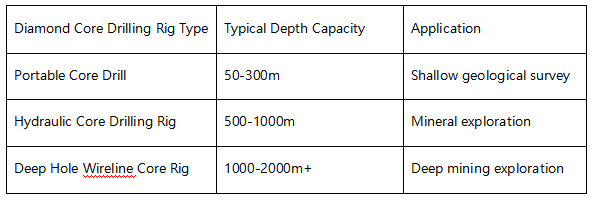
Small Diamond Core Drilling Rigs 50-300m
Lightweight portable core drills are designed for shallow and small-scale exploration tasks. They are widely used in construction foundation investigation, conventional geological sampling, and small mineral resource prospecting. Featuring compact structure, flexible movement, easy transportation, and low investment cost, these rigs are ideal for short-cycle shallow drilling projects with low geological difficulty.
Medium Depth Core Drilling Rigs 500-1000m
As the mainstream equipment in the current mining exploration market, medium-depth hydraulic core drilling rigs balance performance and cost perfectly. They are widely applied in gold, copper, iron ore, and general regional geological survey projects. Equipped with upgraded hydraulic power systems, stable drill rod handling devices, and optimized drilling structures, these rigs deliver higher drilling efficiency and stable core recovery rates, meeting the exploration needs of most conventional mineral resources.
Deep Hole Diamond Core Drilling Rigs 1000m+
Deep hole core drilling rigs are customized for large-scale deep mining exploration projects. To achieve ultra-deep stable drilling, they are equipped with high-torque rotary heads, high-strength integral drill rods, advanced constant-pressure hydraulic systems, and automatic rod handling systems. These configurations effectively reduce drilling resistance and operational errors, supporting continuous and stable drilling operations above 1000 meters for deep buried ore body exploration.
What Determines the Maximum Depth of a Diamond Core Drilling Rig?
The nominal maximum depth of a diamond core drilling rig is a theoretical value. The actual drilling depth of each project is comprehensively restricted by geological conditions, equipment accessories, power performance, and construction technology. The following five factors are the core determinants of drilling depth.
Geological Conditions
Geological rock formation is the primary factor affecting drilling depth and efficiency. Soft rock formations such as limestone, shale, and sandstone have low hardness and weak abrasiveness. Drilling resistance is small, the bit wears slowly, and the rig can maintain a stable drilling speed to reach greater depths smoothly.
In contrast, hard and dense rock formations including granite, basalt, and quartzite bring huge drilling challenges. These rocks require higher drilling pressure and stronger torsion for cutting. They also cause severe wear on diamond bits. Drilling in hard rock needs high-power matched rigs and professional drilling accessories, otherwise it is difficult to reach the preset depth and prone to drilling stagnation.
Drill Rod Quality and Length
As drilling depth increases, drill rods bear superposed weight, continuous rotational torque, and high-frequency vibration. Low-quality drill rods have poor straightness and unstable thread connections. In deep hole operations, they are prone to bending, fracture, and loose connection, directly leading to hole deviation, drilling failure, and even equipment stuck accidents.
Deep depth drilling projects must adopt high-strength alloy drill rods with precise thread processing and excellent overall straightness. Qualified drill rods can uniformly bear mechanical pressure in ultra-deep holes, ensure vertical drilling trajectories, and support long-term stable deep drilling operations.
Core Barrel Size Selection
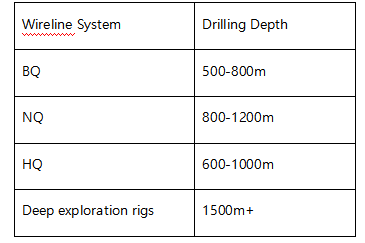
Different core barrel specifications directly match different effective drilling depth ranges, which is a key detail easily ignored in project design. Common industry standard specifications include BQ, NQ, HQ, and PQ, with distinct depth adaptation capabilities.
BQ core barrels support a drilling depth of 300 to 800 meters. With small drilling diameter and low underground resistance, they feature fast penetration speed, suitable for rapid shallow and medium-depth sampling. NQ core barrels are the most widely used specification, adapting to 800 to 1200 meters drilling depth, balancing drilling speed and core sampling quality for most medium and deep exploration projects.
HQ core barrels apply to 500 to 1000 meters drilling. They can obtain larger-diameter core samples, providing more complete data support for accurate geological analysis. PQ core barrels are mainly used for 300 to 800 meters complex ore body exploration. The large-size core samples help researchers analyze complex underground geological structures and ore body distribution rules in detail.
Drilling Rig Power and Torque
Ultra-deep drilling requires sufficient power output and stable power support. Shallow drilling projects only need 50 to 100 kN feed force to complete operations. For deep holes above 1000 meters, the rig needs to be equipped with a high-power engine, 150 kN+ strong feed force, and high rotary torque. Stable hydraulic pressure output ensures continuous cutting and propulsion in deep high-resistance rock formations, avoiding power insufficiently caused drilling shutdown.
Drilling Method
Traditional conventional core drilling requires repeated lifting and lowering of drill rods to take cores, which is inefficient and prone to hole wall collapse in deep holes. Wireline diamond core drilling is the optimal technology for deep exploration. It realizes core taking without lifting the entire drill rod string, greatly saving auxiliary operation time. This method improves core recovery rate and reduces underground disturbance, perfectly adapting to various 1000-meter-level ultra-deep drilling projects.
How Deep Can Wireline Diamond Core Drilling Reach?
Wireline diamond core drilling is currently the most efficient and reliable deep drilling technology in the mineral exploration industry. It solves the pain points of low efficiency and high failure rate of traditional drilling in deep holes, and its achievable depth covers most commercial deep exploration scenarios.
The actual depth of wireline drilling is not fixed. It is adjusted according to on-site rock hardness, drill pipe matching quality, and overall equipment configuration. Matched with professional deep hole rigs and high-quality accessories, wireline drilling can stably break through 1500 meters, meeting the exploration needs of ultra-deep buried ore bodies in large mining areas.
Examples of Deep Diamond Core Drilling Applications
Diamond core drilling with different depth capabilities is widely used in multiple professional scenarios, with mature application cases in high-precision resource exploration and geological research.
Gold Exploration
Most gold ore bodies are deeply buried and have complex distribution. Exploration projects require high-precision continuous core sampling to accurately locate ore body boundaries and reserve scale. Conventional gold exploration drilling depths are maintained at 500 to 1500 meters, relying on medium and deep hole diamond core drilling rigs to complete efficient sampling.
Copper and Metal Mining
Large-scale copper and non-ferrous metal mining projects need large-area deep exploration to verify underground resource reserves. Such projects usually require drilling depths above 1000 meters. Deep hole wireline core drilling equipment ensures continuous core recovery and provides complete data for mine resource evaluation and mining scheme design.
Geological Research Projects
Regional fault investigation, underground rock structure analysis, and geological disaster early warning research require targeted deep drilling sampling. Diamond core drilling rigs with adjustable depth functions can adapt to different research depth requirements, providing accurate core data for geological academic research and engineering construction evaluation.
Signs You Need a Deep Hole Diamond Core Drilling Rig
Choosing a deep hole drilling rig can effectively avoid equipment mismatch and project delay. You need to configure a professional deep hole hydraulic diamond core drilling rig if your project meets the following conditions.
First, the preset drilling depth of the project exceeds 500 meters, and shallow portable rigs cannot meet the depth demand. Second, the project requires complete and continuous core samples without missing underground stratigraphic data. Third, the exploration targets are high-value mineral resources such as gold and copper, which require high-precision deep exploration. Fourth, the construction site is in remote mining areas with complex terrain, requiring stable and durable deep drilling equipment to adapt to harsh working conditions.
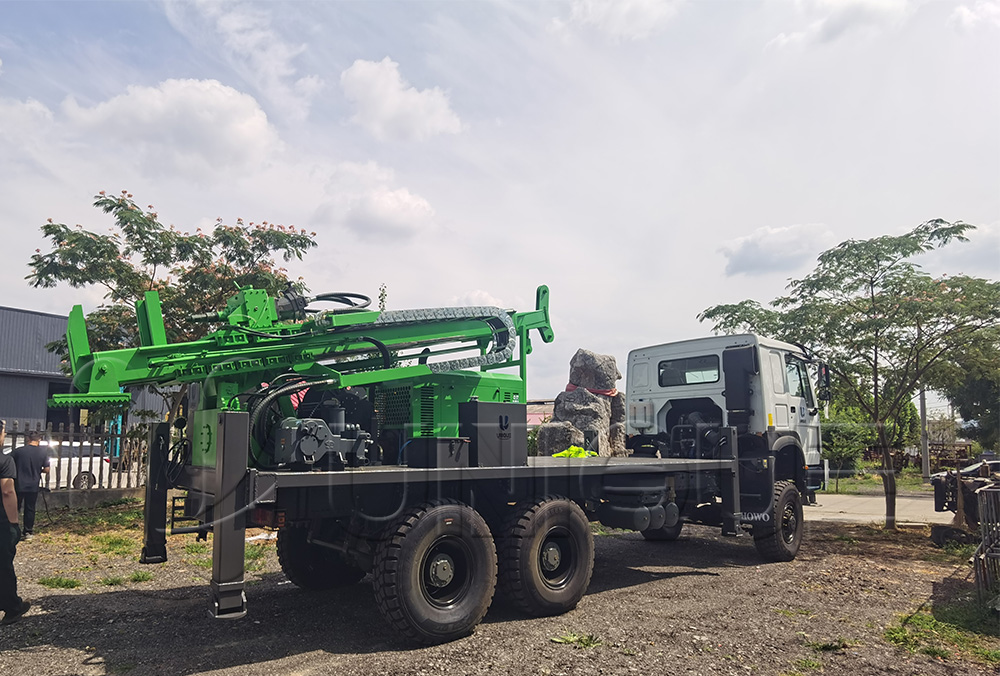
How to Choose the Right Diamond Core Drilling Rig for Your Project?
Reasonable equipment selection is the premise of efficient drilling and cost control. Project contractors can select targeted diamond core drilling equipment through four core steps.
Define Required Drilling Depth
Take the project’s maximum drilling depth as the primary selection standard. Shallow projects within 300 meters can choose portable small core drills. Conventional 500 to 1000 meters mineral exploration is matched with medium hydraulic core drilling rigs. Projects above 1000 meters must select professional deep hole wireline core drilling rigs.
Consider Geological Conditions
Complete a detailed geological survey before purchasing equipment. Judge rock hardness, stratigraphic stability, and drilling difficulty, and select rig power, core barrel specification, and drill rod matching scheme according to actual geological conditions to avoid equipment insufficient power or excessive configuration waste.
Check Key Equipment Specifications
Focus on core performance parameters including maximum drilling depth, rotary torque, engine power, feed force, automatic rod handling system, and hydraulic system stability. High matching parameters ensure stable operation in long-term deep drilling.
Choose Manufacturer Experience
Cooperate with manufacturers with rich industry experience and export qualifications. Focus on brand after-sales service, spare parts supply capacity, and successful project cases to ensure on-site technical support and later equipment maintenance guarantee.
Why Choose a Professional Diamond Core Drilling Rig Manufacturer?
Professional manufacturers can provide customized one-stop drilling solutions for different depth and geological exploration needs. UNIQUEMAC, as a professional core drilling equipment manufacturer, focuses on the research and development and production of hydraulic diamond core drilling rigs and wireline core drilling systems.
The brand provides diversified equipment configuration and customized drilling depth schemes, widely serving mineral exploration, geological survey, and mining engineering projects worldwide. UNIQUEMAC supports whole-process project consultation, personalized equipment customization, and 24-hour online technical support. It can solve various depth and technical problems encountered in on-site drilling for customers, helping projects improve efficiency and reduce costs.
FAQ
Q1: How deep can a diamond core drilling rig drill?
A1: Most standard diamond core drilling rigs can drill depths ranging from 300 meters to 1500 meters. The specific depth depends on equipment configuration, core barrel specification, and actual on-site geological conditions.
Q2: What is the deepest core drilling ever achieved?
A2: Professional scientific geological drilling equipment can reach several kilometers in depth. For commercial mineral exploration, conventional core drilling rigs stably operate within the range of 1000 to 2000 meters, which meets most mining project needs.
Q3: Which is better for deep drilling, wireline or conventional core drilling?
A3: Wireline diamond core drilling is more suitable for deep hole projects above 800 meters. It avoids repeated rod lifting, improves drilling efficiency and core recovery rate, and has lower underground operation risk than conventional drilling methods.
Q4: What size core drilling rig is needed for 1000m drilling?
A4: A high-power hydraulic wireline diamond core drilling rig matched with NQ or HQ core barrel configuration is the most ideal choice for 1000-meter deep drilling projects.
Conclusion
The maximum drilling depth is an important but not the only standard for selecting diamond core drilling rigs. In actual project selection, contractors need to comprehensively measure key factors including target drilling depth, local geological rock conditions, core sample size requirements, drilling efficiency, and long-term operating costs.
Scientific and reasonable equipment matching can effectively reduce unnecessary drilling costs, improve overall construction productivity, and greatly enhance the success rate and data accuracy of mineral exploration and geological survey projects.