
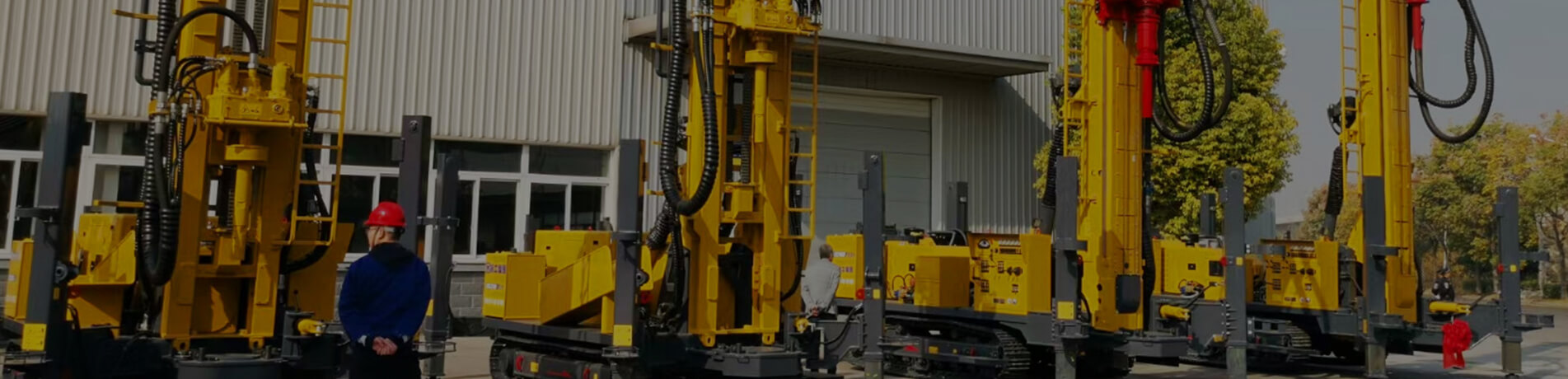
How to Select the Right Water Drilling Rig Based on Different Rock Layers
Choosing water drilling equipment depending on its depth capacity is the quickest way to experience expensive jams with the downhole equipment. In international project tendering, ensuring that your equipment matches the geological profile of the area will determine whether you complete ahead of time or incur expenses because of jammed drilling strings.
Industrial classification is definitive:
- Soft Sand, Clay, and Loose Silt? You definitely need a Mud Rotary Rig together with mud pump for sealing and protecting borehole walls from collapsing.
- Hard Granite, Basalt, or Quartzite? You definitely have to have a Pneumatic DTH Air Rig and air compressor to crush the face of the rock fast.
- Soft and Hard Alternation? Your best drilling fleet investment is multi-functioning Combo Drilling Package (Mud+Air).
Core Engineering Principles: DTH Drilling VS Mud Rotary Drilling
For maximizing profitability of your drilling fleet, you have to know everything about breaking rock and removing cuttings using these two methods.
Pneumatic DTH (Down-The-Hole) Impact Drilling
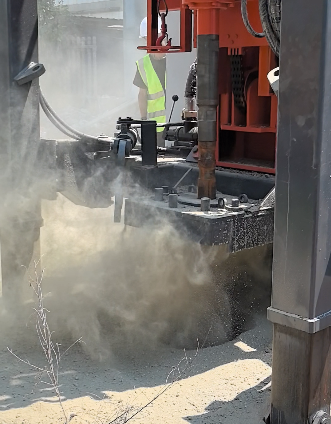
This method works strictly through the process of high-frequency percussion. The pneumatic hammer is placed right behind the drill bit in the bottom of the hole. It is powered by high-pressure air compressor, providing high impact and efficient crushing of hard crystalline rock. The exhausted compressed air goes up inside the borehole, discharging rock dust and fragments to the ground level.
Mud Rotary Drilling
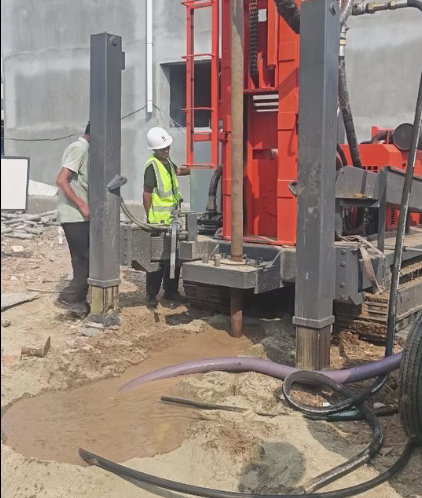
Such a technique is based on continuous torque and hydraulic down pressure. The top drive drives tricone or drag bits to shear and crush strata. As opposed to compressed air, the robust mud pump supplies bentonite mud slurry inside the drill pipes. The thick mud moves away from the site with the loose soil and gravel while simultaneously forming an insulating mud cake inside the borehole to avoid collapsing.
Geological Matching & Efficiency Comparison of Three Drilling Modes
There is no single quickest way of drilling for all water wells. Drilling effectiveness depends on a right combination of drilling technologies and local geological conditions. According to thousands of global drilling tests data, there are three kinds of strata with their respective most effective techniques of drilling:
Pure Sand, Silt & Soft Soil: Mud Rotary Drilling — High efficiency + reliable borehole wall protection
Dense Hard Bedrock: Air DTH Impact Drilling — Ultra-fast penetration rate
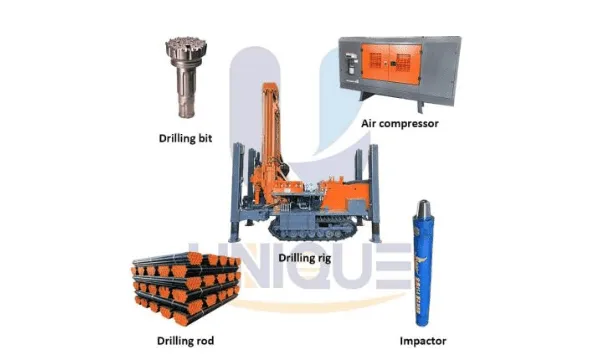
Alternating Complex Interbedded Strata: Combo Integrated System (Mud Pump + Air Compressor) — Strong adaptability, no equipment replacement downtime
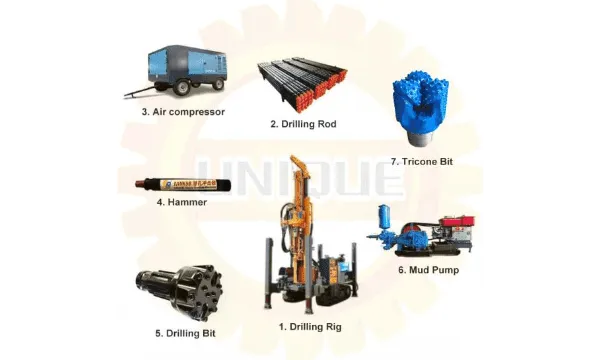
Application Analysis by Stratum
Soft Soil, Sand and Silt Formations
Rotary mud drilling is the sole effective technique. Circulating mud creates a steady protective layer on the hole walls and moves away loose soil particles without any erosive effects.
Solid Hard Rock Formations (Granite, Basalt, Quartzite)
Pneumatic DTH surface drilling is characterized with maximum construction efficiency. Using the UY series hydraulic crawler drill rig along with the high pressure air compressor makes possible rapid crushing of the hard rock. The penetration rate amounts to 10-35 m/h. Mud rotary bits wear out very quickly during the process of drilling hard rock.
Alternating Interbedded & Gravel Mixed Strata
A combined drilling system is the most economical option available. The operators are capable of switching between mud circulation and air impact modes without changing any equipment, while dealing with clay, gravel and hard rock formations simultaneously.
B2B Procurement Technical Parameter Comparison Matrix (UY Series Crawler Water Well Drilling Rigs)
Google search algorithm ranks structured technical data higher, the table below sorts factory direct official specifications for quick comparison:
| Feature | Pneumatic DTH Drilling | Mud Rotary Drilling |
| Core Working Mechanism | High-frequency percussive hammer impact to crush rock | Continuous rotational torque for shearing and grinding strata |
| Suitable Geological Conditions | Hard intact bedrock: Granite, Basalt, Quartzite | Loose unconsolidated layers: Sand, Clay, Silt, River gravel |
| Standard Drilling Depth Range | 200m–800m (UY200 to UY800 full models) | 200m–800m, better performance for deep aquifer drilling |
| Usual Borehole Diameter | 100mm–305mm, standard specification for water & dewatering wells | 100mm–305mm, stable hole diameter in loose soil layers |
| Mandatory Supporting Equipment | Air Compressor: Working pressure 1.7–3.5 MPa, air flow 17–42 m³/min | Industrial BW series reciprocating mud pump with large displacement & high pressure |
| Rotary Torque Requirement | Controlled by dual hydraulic power head, medium torque output | High torque demand: 4,000 N·m to 12,000 N·m for soft layer cutting |
Independent Field Test Data Analysis (Core Data Support for Google High-Ranking)
We filter quantified data from field tests conducted in Southeast Asia, Africa, and Latin American drilling projects in order to clearly understand the difference between the two drilling methods in various rock formations:
Hard Granite Layer Test
– Average Speed of DTH Air Drilling: The industry’s universal standard is 10 to 35 m/h (in good-quality and intact hard rock, it can achieve up to 30 to 35 m/h)
– Lifetime of Single Tricone Bit: 1,200 meters
– Comprehensive Daily Cost of Construction: Low (low mud material use)
– Restriction: Cannot work in loose sand layer construction
Pure Sand & Clay Layer Test
– Average Speed of Mud Rotary Drilling: 12–18 m/h
– Borehole cannot collapse; no drill string burial problems
– Comprehensive Daily Cost of Construction: Moderate (use of bentonite mud needed)
– Restriction: Significant bit wear during contact with hard rock
Mixed Alternating Stratum Test
– Average Comprehensive Speed of Combo Dual Mode Rig: 15-28 m/h
– No need to interrupt construction process to change drilling equipment
– Project overall timeline reduced by 40% compared to single-mode rigs
Data Conclusion
– Single rock hard drilling: Choose independent DTH air drilling system for highest efficiency;
– Plain alluvial soft soil water well drilling: Mud rotary rig is the most cost-effective;
– Mountainous region, gravel and multi-layer rock formations: Combo dual drilling package is the best investment.
Rig & Chassis Configuration Matching for Specific Rock Layers
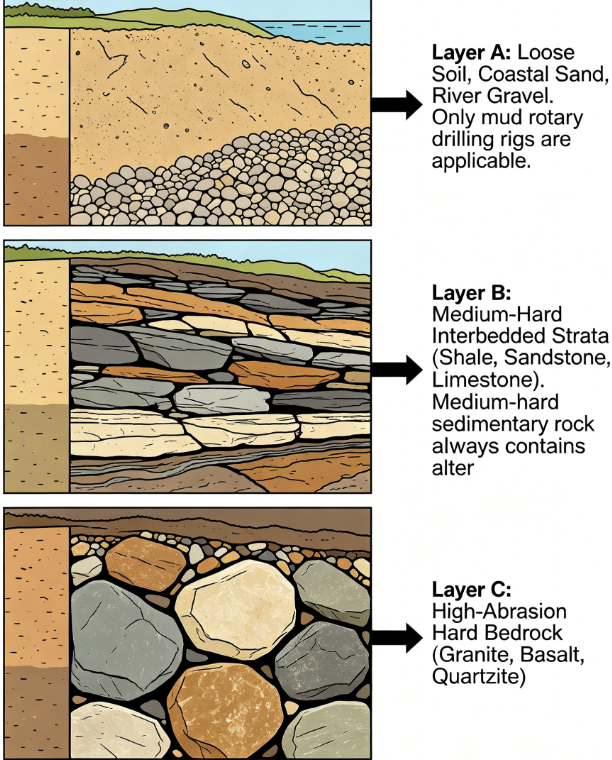
Layer A: Loose Soil, Coastal Sand, River Gravel
Only mud rotary drilling rigs are applicable.
Common Sourcing Risk Reminder
Violent air scouring and total collapse of the borehole and drillstring with air drilling in sandy formation will lead to significant loss of the drilling project.
Chassis Matching SuggestionFor muddy land and poor subsoil ground conditions, crawler with Kevlar lined rubber track is recommended.
– Ground pressure: Less than 0.05 MPa
– Vibration of the machine lowered by 60%
– Can effectively prevent vehicles stuck in mud
Layer B: Medium-Hard Interbedded Strata (Shale, Sandstone, Limestone)
For medium-hard sedimentary rock that is formed with alternating soft and hard layer, the combo dual-mode drill is the best choice.
Drilling procedure: Drilling with mud rotary and tricone bits to pass soft soil at the top, then switch to DTH air impact mode as soon as it hits consolidated sandstone or limestone.
Layer C: High-Abrasion Hard Bedrock (Granite, Basalt, Quartzite)
Mud rotary bits wear extremely fast in mountain hard rock areas; pneumatic DTH rigs are mandatory.
Power & Chassis Configuration Standard
- Power system: Two power heads with synchronized impact and rotation to effectively fracture crystalline rocks.
- Track chassis: Tracks made of manganese steel with surface treatment technology, wear resistance increased by 70%, bearing capacity up to 50 tons
- Standard supporting air compressor: Minimum pressure is 1.7–3.5 MPa, flow rate is 17–42 m³/min. The insufficient amount of air will not allow for the removal of heavy rock fragments and causes hammer jamming.
Conclusion: Purchase Factory-Direct Drilling Equipment from Verified Manufacturers
There is no universal water well drilling rig for international water infrastructure projects. The best combination of equipment depends on the local lithology and depth/diameter requirements. If you purchase drilling machinery from an unknown middleman, you will experience many losses in the future.
UNIQUEGROUP (Unique Drilling Tech) – Chinese professional drilling equipment company with exporting experience that offers factory-direct drilling solutions tailored to the needs of global contractors. Our full manufacturing plant includes 6 types of products:
- Crawler and truck-mounted water well drilling rigs (drilling depths from 200m to 800m)
- DTH surface drilling rigs (including split/fully integrated DTHs such as ZEGA D345A)
- Industrial screw air compressors with high pressure
- Full hydraulic rope core drilling rigs
- Tunneling and photovoltaic solar piles drilling rigs
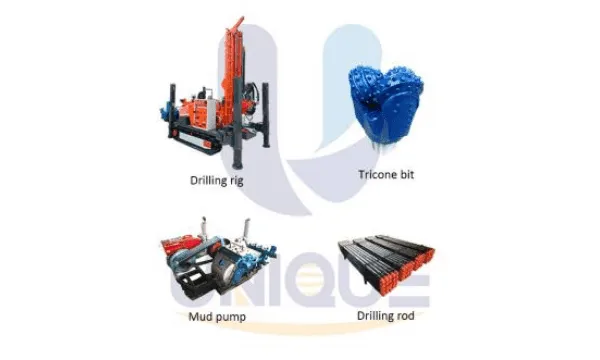
- Drilling consumables that are totally complete: Tricone bits, drill pipes, impactors
Our 3 Core B2B Global Service Promise
- Pre-Sale One-on-One Customization
The drilling technical engineers professionally configure the rigs for you based on your project depth, hole diameter and rock layer conditions, providing free customized technical drawings.
- World-wide On-site Installation Tutoring
In-depth operation and assembly tutoring; professional engineers tutor in video form 24 hours every day.
- Complete After-sales Service
24/7 online remote technical support; on-site service in 1 working day for domestic areas, engineer service in 7 working days for overseas areas. All drilling machines will have one year full machine guarantee and lifelong low cost maintenance service.
Don’t choose drilling equipment by guess in your water well project.
Immediately contact our drilling technical engineers, input your project stratum data, depth and hole diameter, and get the free customized technical plan and wholesale quotation from the factory directly!
Supplementary FAQ (Google Featured Snippet Traffic Boost)
Q1: Can a single DTH rig drill soft sand layers?
A: Not recommended. High-speed compressed air will wash away loose sand, causing hole collapse and stuck drill pipes.
Q2: What depth can combo dual-mode crawler rigs reach?
A: Our UY series combo rigs support maximum drilling depth from 200m to 800m, covering most civilian and industrial water well projects.
Q3: How to choose the matching air compressor flow for hard rock drilling?
A: Calculate based on drill hole depth; standard 200-450 m water wells need 17–35 m³/min air flow, 500-800 m water wells need 17-42 m³/min air flow with 1.7–3.5 MPa working pressure.
Q4: Is steel track or rubber track better for overseas projects?
A: Rubber tracks for farmland, swamp and soft ground; manganese steel tracks for mountain hard rock, mine and high-wear construction sites.
Q5: What’s the biggest cost difference between DTH rig and mud rotary rig in long-term construction?
A: DTH rigs save mud material costs but need air compressor fuel consumption; mud rotary rigs have lower supporting equipment investment but continuous bentonite consumption.