
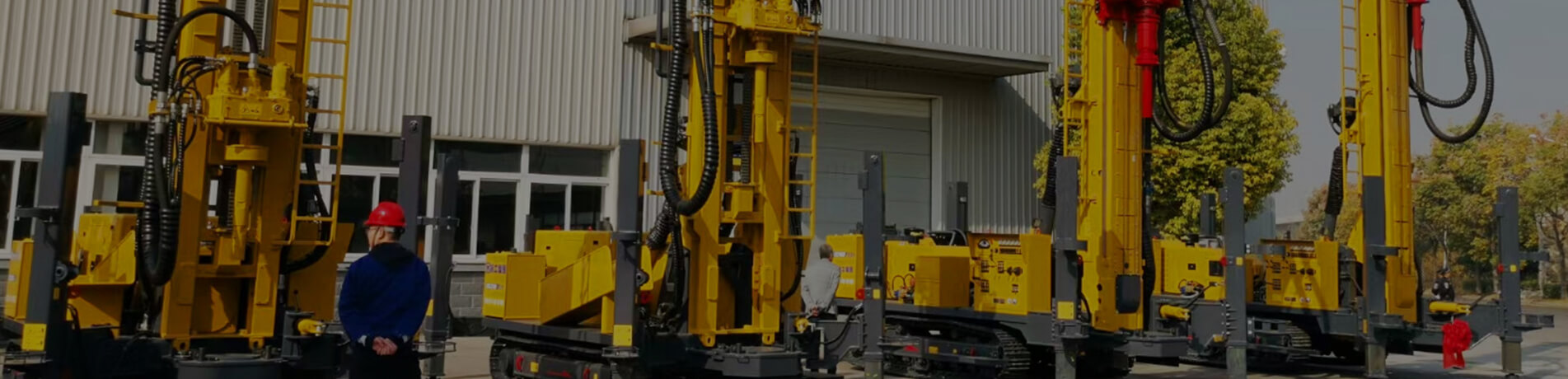
How to Choose the Right Air Compressor for Drilling Applications?
Introduction: Why Choosing the Right Air Compressor Matters in Drilling Projects
Many drilling project delays, low productivity and cost overruns are not caused by underperforming drilling rigs or unskilled operators. They stem from one critical underestimated factor an improperly matched air compressor system. Most drilling contractors focus heavily on rig specifications yet treat air compressors as ordinary auxiliary equipment, which leads to inefficient rock breaking, slow penetration and frequent on site downtime.
An air compressor for drilling applications is a power source that provides compressed air to operate drilling tools, remove cuttings, and improve drilling efficiency. This core equipment directly determines four key project indicators including overall drilling speed, rock breaking efficiency, hole cleaning performance and final drilling cost per meter. Different drilling techniques require unique air pressure and airflow output standards. Therefore, selecting a tailored air compressor solution is the fundamental guarantee for stable, efficient and cost effective drilling project operation.
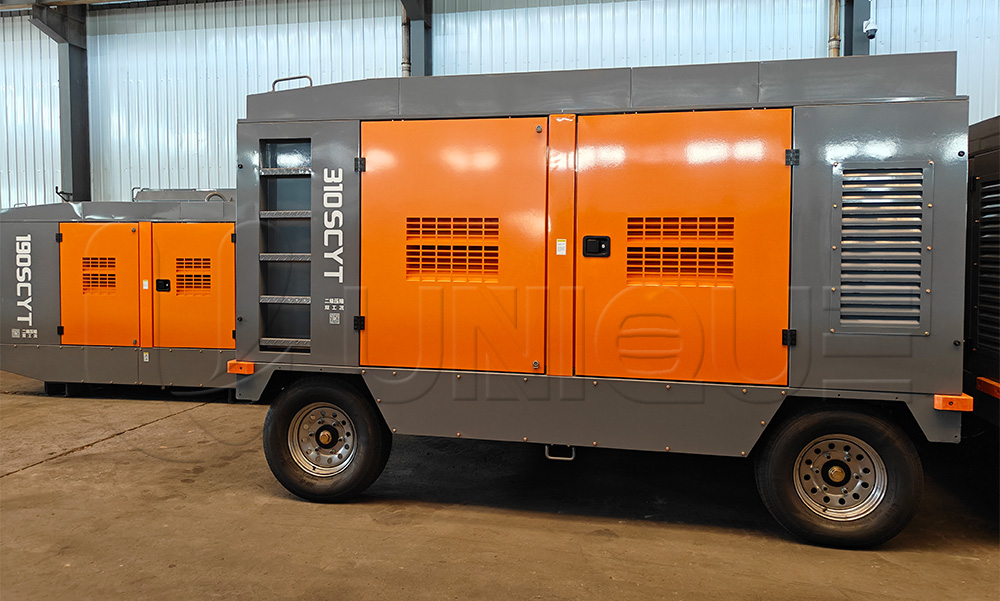
What Is the Role of an Air Compressor in Drilling Applications
Providing Power for DTH Hammer Drilling
DTH drilling is the most widely used hard rock drilling method in mining, quarrying and infrastructure projects, and it fully relies on qualified compressed air to complete core operations. The complete working process follows a fixed and efficient transmission logic. The professional DTH drilling air compressor generates stable high power compressed air, which flows through the entire drill pipe and delivers continuous power to the DTH hammer at the bottom of the hole. The compressed air drives the internal piston structure of the hammer to generate high frequency impact energy, which acts directly on hard rock strata to achieve efficient rock breaking.
Without stable compressed air for rock drilling, the DTH hammer cannot reach standard impact frequency and force, resulting in incomplete rock crushing and greatly reduced drilling progress. High quality matched air supply ensures continuous and stable operation of down hole tools, which is the core premise of efficient hard rock drilling.
Improving Cuttings Removal During Drilling
A large amount of rock cuttings and debris will be produced continuously during the whole drilling process. If these residues accumulate at the hole bottom, they will cause repeated crushing of rock layers, increase drilling tool wear and seriously hinder drilling speed. Compressed air acts as an efficient hole cleaning medium to blow away bottom hole cuttings in real time and discharge all debris out of the drill hole.
Effective cuttings removal keeps the drill bit in direct contact with intact rock strata at all times, avoids invalid repeated work, and greatly improves overall drilling efficiency. This function is particularly critical for hard rock drilling and deep hole drilling scenarios, where poor slag discharge is the main cause of low drilling efficiency and tool damage.
Supporting Reverse Circulation Drilling
Reverse circulation drilling is a high precision geological exploration drilling method, and its whole working system is highly dependent on sufficient and stable airflow. Different from DTH drilling that focuses on impact power, RC drilling air compressor mainly undertakes the task of rock sample transportation. Stable high volume airflow can lift complete and unbroken rock samples from deep strata to the ground surface through the inner drill pipe.
Reliable air supply ensures complete sample collection, avoids sample loss and contamination, and guarantees the accuracy of geological data. Accurate rock sample information provides reliable basis for stratum analysis, resource reserve evaluation and subsequent project design, which determines the scientificity and practicability of the whole exploration project.
Key Factors to Consider When Choosing an Air Compressor for Drilling
Air Pressure
Air pressure measured in bar or PSI is the basic parameter that determines whether the compressor can drive drilling tools normally and adapt to different drilling depths. Air pressure directly supports the impact power of down hole hammers and the penetration capacity of drilling equipment. In shallow hole drilling projects, the stratum resistance is small and the air pressure loss in the drill pipe is low, so the equipment only needs low to medium pressure output to meet construction demands.
For deep hole drilling and complex hard rock strata, long distance air transmission will produce obvious pressure loss, and high formation hardness requires stronger impact power. In this case, a high pressure drilling compressor with stable high pressure output is essential. It is worth noting that higher pressure does not always mean better performance. The optimal choice is to match the pressure parameters with the actual drilling rig and down hole tool specifications to avoid performance redundancy and energy waste.
Air Flow Capacity
Air flow capacity represented by CFM or Cubic Feet per Minute is the core parameter affecting drilling stability and efficiency. CFM determines the continuous supply capacity of compressed air, directly influencing DTH hammer operating performance, overall drilling speed and hole cleaning effect. Insufficient CFM will trigger a series of on site problems including reduced hammer impact force, incomplete rock removal and continuous decline in drilling speed.
Different drilling methods have completely different CFM requirements, which can be clearly referred to in the industry standard matching range. Small scale shallow DTH drilling adapts to low and medium CFM configuration. Deep hole DTH drilling for hard rock needs high CFM support to maintain stable power output. RC drilling that relies on airflow transportation of rock samples requires very high CFM to ensure efficient and complete sample conveying.
Matching Compressor Size with Drilling Rig Capacity
Many contractors blindly pursue large power compressors, ignoring the matching degree between equipment and drilling systems. Excessively large compressor size will lead to higher fuel consumption, increased equipment procurement investment and long term idle performance waste. On the contrary, if the compressor model is too small to match the rig capacity, the equipment will operate under overload conditions for a long time, resulting in decreased working efficiency, frequent equipment failures and increased unplanned downtime risks.
The core selection principle is clear and practical. The right compressor is not always the largest one, but the one that matches the drilling system. Scientific size matching can maximize equipment efficiency, control operating costs and ensure long term stable operation of the drilling system.
Compressor Type and Mobility
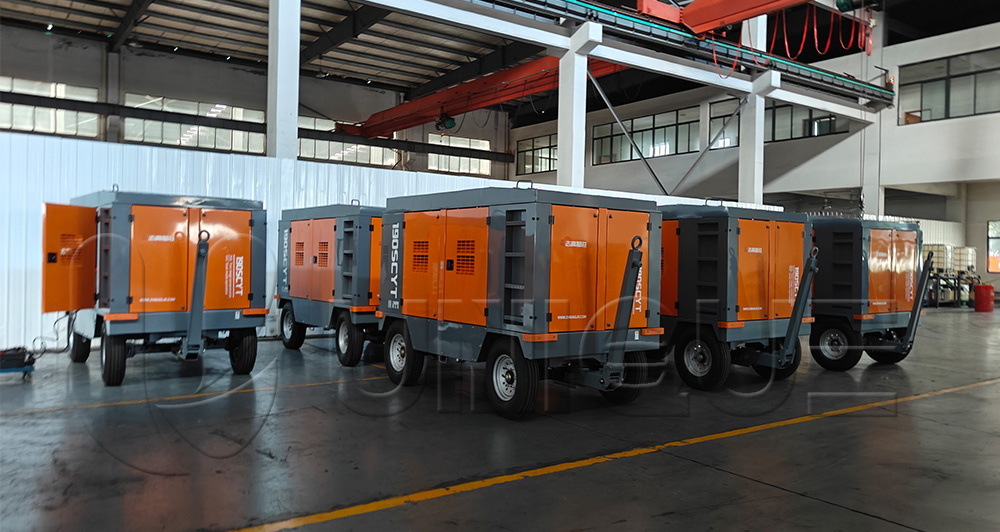
According to structural form and application scenarios, drilling compressors are mainly divided into portable diesel air compressors and stationary compressors. Portable diesel air compressors are the mainstream choice for field drilling projects. They are equipped with independent diesel power systems, no need for external power supply, and feature flexible transportation and rapid on site deployment. This type of equipment is perfectly suitable for remote drilling sites, mountain mining areas and scattered water well drilling projects with incomplete supporting facilities.
Stationary compressors are mostly used for fixed industrial drilling scenarios with stable power supply and fixed construction locations. They have stable output but poor flexibility, and cannot adapt to mobile and complex field drilling operations. Contractors need to select equipment types according to project mobility and site conditions.
Choosing an Air Compressor Based on Different Drilling Methods
Air Compressor Selection for DTH Drilling
DTH drilling is mainly used for hard rock and deep hole construction in mines, quarries and water well projects. Its working characteristics determine strict equipment matching standards. The whole drilling process requires continuous high impact energy to crush dense hard rock strata. Therefore, the matched compressor must have high CFM output, ultra stable pressure performance and long term continuous operation capability. Stable high airflow and pressure ensure that the DTH hammer maintains consistent impact frequency in deep hole environments, avoids power attenuation caused by depth increase, and guarantees continuous and efficient rock breaking effect. Long term continuous operation performance can adapt to high intensity uninterrupted construction needs of large scale mining projects.
Air Compressor Selection for RC Drilling
RC drilling focuses on geological exploration and rock sample collection, and its core demand is large volume and stable airflow. Different from DTH drilling’s demand for high impact pressure, RC drilling requires compressors to provide lasting and uniform high airflow to lift deep rock samples completely.
Only sufficient and stable air volume can ensure efficient sample transportation, avoid sample blockage and loss in the drill pipe, and ensure the authenticity and integrity of geological data. Therefore, high CFM output and stable pressure control are the core indicators for selecting RC drilling air compressors.
Air Compressor Selection for Water Well Drilling
Water well drilling projects involve complex stratum conditions including loose soil layers and hard rock layers, and most of them are deep hole construction. Compressed air plays two key roles in water well drilling. First, it completes efficient hole cleaning and timely discharges underground rock cuttings and sediment to prevent hole collapse and blockage. Second, it optimizes down hole working conditions, reduces drilling tool resistance and effectively improves drilling penetration rate.
The matched compressor needs to have stable airflow regulation performance, which can adapt to the switching of different stratum conditions, ensure smooth progress of water well drilling, and improve the finished well quality and construction efficiency.
Common Mistakes When Selecting a Drilling Air Compressor
Most long term high cost problems of drilling projects come from several common selection mistakes. Avoiding these misunderstandings is the key to improving project profitability.
The first mistake is choosing compressor only based on price. Low price equipment usually has unstable performance, insufficient power reserve and poor durability. In actual operation, it will lead to low drilling efficiency, frequent failures and repeated maintenance. The later maintenance cost and delayed project loss far exceed the initial equipment price advantage, resulting in higher overall drilling cost.
The second mistake is ignoring geological conditions. Soft soil and loose strata have low requirements for airflow and pressure. However, hard rock and dense composite strata require higher airflow and stable pressure output. Blind selection without referring to stratum conditions will lead to insufficient power and failed construction.
The third mistake is neglecting future project expansion. Many contractors only match equipment according to current shallow hole and low difficulty projects. Once the subsequent project involves deeper drilling, harder strata and new drilling methods, the existing compressor will be unable to meet the demand, resulting in repeated equipment investment and resource waste.
How to Calculate the Required Air Compressor for a Drilling Project
Scientific compressor capacity calculation is the premise of accurate matching. Three core factors need to be fully considered in the calculation process. First is drill depth. The deeper the drilling depth, the more obvious the air pressure and airflow loss in the drill pipe, requiring higher equipment power reserve. Second is drill diameter. Larger drill holes need more airflow to complete hole cleaning and rock sample transportation. Third is rock hardness. Harder rock strata require stronger impact energy and higher air supply demand.
The general calculation logic for field construction is clear and practical. Required Compressor Capacity equals the sum of basic drilling tool requirement, pipeline depth loss and reasonable safety margin. Reserving a certain safety margin can avoid insufficient air supply caused by environmental changes and equipment aging, and ensure long term stable operation of the system.
Why Choose UNIQUEMAC Drilling Air Compressor Solutions
For drilling contractors, choosing the right compressor requires more than purchasing a powerful machine. It needs a professional overall solution matching project working conditions and drilling techniques. UNIQUEMAC focuses on the actual pain points of field drilling and provides targeted and reliable air compressor solutions for global drilling projects.
UNIQUEMAC equipment has reliable air supply performance. It can output stable airflow and constant pressure for a long time, completely adapting to high intensity continuous drilling operation and avoiding efficiency fluctuation caused by unstable air supply. All products are professionally designed for drilling applications, perfectly matching DTH drilling, RC drilling and water well drilling scenarios, with strong scene compatibility.
In terms of field performance, UNIQUEMAC drilling compressors adopt rugged industrial design, adapting to harsh working environments such as high temperature, low temperature and dust. Meanwhile, the equipment has excellent fuel economy, effectively reducing long term operating costs. The simple and compact structural design reduces daily maintenance difficulty, shortens equipment downtime and maximizes project construction efficiency.
Frequently Asked Questions About Drilling Air Compressors
FAQ 1: What size air compressor do I need for a drilling rig?
The size of the required compressor depends on four core factors including specific drilling method, final drilling depth, DTH hammer size and actual rock formation condition. Professional matching needs to comprehensively calculate air pressure and airflow demand to determine the most suitable model.
FAQ 2: How much CFM does a DTH drill require?
The CFM requirement of a DTH drill is determined by hammer diameter, drilling depth and formation hardness. Larger hammers, deeper holes and harder rock strata all require higher CFM output to maintain efficient drilling operation.
FAQ 3: Can one air compressor be used for different drilling applications?
A single compressor can adapt to multiple drilling scenarios on the premise of sufficient airflow capacity, reasonable pressure range and good equipment compatibility. Professional parameter matching can realize multi scene multiplexing and improve equipment utilization.
FAQ 4: Why is compressed air important in rock drilling?
Compressed air is the core power source of rock drilling. It powers down hole drilling tools to complete rock breaking, removes underground rock cuttings to ensure smooth hole forming, and greatly improves overall drilling penetration efficiency and construction quality.
Conclusion: Choosing the Right Compressor Improves Drilling Efficiency
The air compressor is the core power equipment that determines the efficiency, quality and cost of drilling projects. Scientific selection must be based on comprehensive factors including targeted drilling method, required air pressure and airflow parameters, geological stratum conditions and actual project operating environment. Matching professional compressor equipment can effectively improve rock breaking efficiency, speed up drilling progress, reduce equipment failure rate and control comprehensive construction costs. Choosing a tailored and reliable drilling air compressor solution is the most cost effective investment for long term stable operation and profit improvement of drilling projects.